Sunday, March 19, 2006

Maryland politics 03/19/06
Mayor Martin O'Malley of Baltimore wants his record as Mayor to serve as the resume that voters will use to hire him as governor of Maryland. The Baltimore Sun in "For Better or Worse" feels that voters should look at his whole record, not just that stubborn crime issue
Mr. O'Malley's critics will keep hounding him on his record on crime - this single-issue attack has become popular, especially among Republicans nationally. But a measure of Baltimore's livability should reflect all aspects of city life, from crime on the street to the downtown skyline to social and cultural amenities.


But how about a different indicator? What about people voting with their feet. In an article praising O'Malley for reversing Baltimore's decline comes this
Still, it's worth noting that the sharp slowing of population declines in older industrial cities is by no means a given. Just consider Detroit, down about 50,000 people, or 5 percent, this decade. Or Philadelphia, down 47,000, or 3 percent. Or Cleveland, off 20,000, or about 4 percent.

Baltimore's decline: 1.5 percent.


Baltimore is still losing population. Not at the extreme rate in the 90's when it was run by Kurt Schmoke, but still more people are leaving Baltimore than coming to Baltimore. The rate of loss may have declined, but the loss of people continues.

Monoblogue reports on "Update on HB1510".
Since there was an article today in the Daily Times and I found out in looking the bill status up that a hearing on it was held today, it appears that the so-called “son of Wal-Mart” may be gaining traction.


IOW, there's a movement afoot to extend the same courtesy to all businesses that the Maryland legislature has extended to Wal-Mart: dictate to all businesses the resources they must expend on providing healthcare for their employees.

Anyone for insisting that "an economic impact statement" be completed before Maryland's legislature decides anything that will affect business.

And Monoblogue tells us further that Senate candidate, Ben Cardin, would like to do for America what the General Assembly has done for Maryland. In "Another one to stop" Monoblogue notes an interview with Cardin and comments
So, not only would we get tagged with higher taxes and a health insurance mandate here in Maryland if HB1510 passes, but if Cardin wins (and remember, his term would extend beyond the 2008 presidential election and could be the same time as Hillary’s re-election) we might have the same thing nationwide.


Meanwhile there's a Republican running for Rep. Cardin's old seat. Dr. Gary Applebaum. At least Dr. Applebaum seems to have an understanding of the basics of economics.
We must strengthen the economy by providing an environment for business generation and growth via tax constraint and reasonable regulation.

In the past 25 years, due to lower tax rates and moderate business regulation, our nation’s wealth has increased more than in its first 200 years.

Americans are better shoppers for goods and services than the government. By keeping taxes low and putting the purchasing power into the hands of consumers, we will have continued economic growth and families will prosper.


Technorati tags: , , , .

Sunday, March 12, 2006

Haveil Havalim #61 is UP!

Jack's Shack hits one out of the park with Haveil Havalim #61- Call Me Roger Maris. And he has more than one motif, not just baseball (with spring training underway) but also Purim. Call this the Haveil Havalim Purim Carnival!

March 19, 2006 - Edition 62. Shiloh Musings (or one of her alter-egos; "gam shiloh ha-blog ahsita mishtei nashim") is scheduled to host the post purim shpiel. Call it our Shushan Purim Carnival. Her e-mail is shilohmuse at yahoo dot com.
March 26, 2005 - Edition 63. New host Reb Chaim HaQoton has volunteered. e-mail him with your suggestions at rchaimqoton at gmail dot com.
Thank you for volunteering and having volunteered; you're the ones who do the work to keep this project going!
In addition to e-mail you may submit entries to Haveil Havalim using either Conservative Cat's handy dandy submission form or the submission form over at BlogCarnival.
Listed at the Truth Laid Bare Ubercarnival.
Technorati Tags: , , , .
Continue reading to see past editions
Most recent editions of Haveil Havalim at Blog Carnival#22 Mystical Paths#21 Rabbinical Authority Consortium of HACKers#20 Shiloh Musings#19 Devarim#18 Soccer Dad#17 Mystical Paths#16 Critical Mastiff#15 Soccer Dad#14 Multiple Mentality#13 IsraPundit#12 DovBear#11 Kesher Talk#10 Biur Chametz#9 Soccer Dad#8 It's Almost Supernatural#7 Bloghead#6 Willow Tree.#5 Crossing the Rubicon2#4 Dov Bear#3 Biur Chametz
Rebbetzin Esther Ritchie

In her younger days she rose to fame by wearing her underwear prominently on stage; nowadays she stays modestly covered in an ankle length slit skirt and low cut but long sleeved blouse. Rebbetzin Esther Ritchie used to be known as Madonna.
In the 80's she was an extremely popular singer breaking taboos right and left. Now she works, supporting her husband Rabbi Akiva Ritchie as he learns in a Kollel in Bnei Brak.
It might be difficult but as Rebbetzin Ritchie puts it, "Boruch Hashem with the royalties from the sale of my book 'Sex' and my somewhat scaled back touring schedule we're able to make ends meet."
Yes, the Rebbetzin still tours. Now she only performs in front of women; usually teenagers. Her new repertoire includes songs like "Stay a virgin," "Justify my emunah(faith)" and "Tatee please schmooze" instilling Torah values in the next generation of young Jewish women.
The change came about after a few years of her Kabbalah period. According to the Rebbetzin, "After dabbling in Kabbalah for a few years, I realized that it was probably just the tip of a rich and fulfilling religion. So I started asking questions and it brought me and my Akiva closer to God and to Judaism."
Her husband, who used to be known as Guy Ritchie took the name Akiva alluding to the fact that he came to Judaism late in life. And though he spends most of his time studying the Talmud these days, Rabbi Akiva Ritchie is now at work, plying his old skills, as the director of "Ushpizin Beis: Shemini Atzeres"
The couple two children also have adopted the new Orthodox lifestyle. Daughter Lourdes has taken the Jewish name "Mikveh" and son, Rocco, is now Rachamim learning in Cheder.
"People are surprised that a Catholic girl from a blue collar home in Detroit is now a Kollel wife. But is it really any stranger than someone with my background becoming a star by performing half naked?"
Technorati tags: , .
Not funny
I thought that the Muqata had an excellent idea. Do spoofs of regular Jewish bloggers. Some were good. The good spoofs were the ones where fans of a blog recreated the blogs recalling the style of the original.
The Purim Mirty's Place was particularly good capturing the style of the original and poking gentle fun of it.
Though, based on the comments, I'm outnumbered (along with Elie's Expositions), the Purim version of Cross Currents was disgraceful. I suppose it may have been mildly amusing but the reference to "Birth of a Nation" changed it from kidding to vicious. I know there are those for whom satire is defined by viciousness, and that there is a market for such an approach. But that doesn't make it funny.
Additionally mocking Cross currents for selectively allowing comments is not fair. Cross currents has a very clear policy that it doesn't intend to publish every single comment. Besides if one objects to what one reads at Cross currents, one still may object elsewhere. What I find cowardly is someone who uses his anonymity to slander others and offers no recourse for amends.
Finally the upside down JIB award was again, not making fun, but an expression of contempt.
I understand satire as well as the next guy, but there are times when satire is not funny and just mean spirited. This was one of them.
Technorati tags: , .
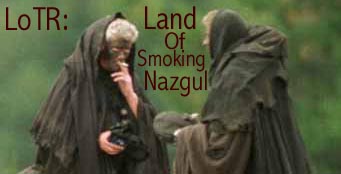
Smoking nazgul
Where have I seen this before?
Oh, yes, here.
Technorati tags: ,

Monday, March 21, 2005

untitled

A belated siyum/daf yomi post

I've wanted to post about the Siyum Ha-Shas nearly 2 weeks ago. I took my two older sons to the Convention Center in downtown Baltimore. The whole idea of hooking up venues around the globe to participate in a single event such as this is quite impressive. (7 1/2 years ago New York magazine termed the tickets for the Siyum in MSG as the "hardest tickets to score" - or some similar language - at that time.)
Unlike last time though, I felt that I had a part in this Siyum. Unlike Cosmic X who's finishing the whole Shas - Talmud - a little late, I fell behind during Shabbos - the second tractate - and dropped out during Eruvin - the third. I just didn't have the dedication. Still I did participate in the process for a time.
Crossing the Rubicon has links to a variety of articles on the topic. via Destination Jerusalem we can find an excerpt of "From September 11 to the Daf Yomi" at Chareidi Wannabe. (The complete story was in the Siyum program and a recent issue of Jewish Observer.)
My Obiter Dicta expresses his conflict over learning Daf Yomi and concludes with beautiful thoughts from his brother. Biur Chametz has the goods on Halacha Yomi.
Point of Pinchas who took the famous "Siyum Hashas" photo from Route 3 in NJ links to his collection of photos.
I've started doing Daf with my 12 and 11 year old boys. Judith at Kesher Talk has started doing Daf too. In fact everyone seems to be doing Daf :-)!
For insights on the Daf don't miss Parshablog or A-Daf-A-Day.
UPDATE: For the past week, I've had the pleasure of doing Daf with my brother (as well as my two sons.) Some of my best learning I did with my brother 25 or so years ago. We learned the last three perakim of Berachos and the last perek of Pesachim with Rashi, Rash and Mishneh Brurah. It's wonderful to see the progression from opinions of the Tanaim and Amoraim to the eventual practical Halacha. To this day I insist on using Siddurim and Bentchers that have the special prayer for the host.
That prayer appears in many more publications now; but was still a novelty 25 years ago.
Also 25 years ago my brother kept asking me, "It's a beautiful possuk (passage from the Bible) where do we say it?" The answer, invariably was "V'Yitain Lecho", a prayer many, but not all, say after Shabbos. I didn't say it then. But on Wednesday night (I think) I proudly pointed to my brother the possuk from "V'Yitain Lecho."
Also thanks to Presence for Blogdigger. I found some of these sites by a Blogdigger search on "Daf Yomi."

Tuesday, March 15, 2005

untitled

Haveil Havalim #13 Announcement

Haveil Havalim #13 is up at Israpundit. Please check it out and read fascinating posts from around the Jewish and Israel related blogosphere!

Multiple Menality plans to host Haveil Havlim #14, March 20, 2004. Pleast e-mail your (self) nominations to thelistener@gmail.com or, send them here to dhgerstman at hotmail dot com this week.

If you are a blogger and wish to host Haveil Havalim, please inform me at dhgerstman at hotmail dot com.
Continue reading to see previous editions.

#12 DovBear
#11 Kesher Talk
#10 Biur Chametz
#9 Soccer Dad
#8 It's Almost Supernatural
#7 Bloghead
#6 Willow Tree.
#5 Crossing the Rubicon2
#4 Dov Bear
#3 Biur Chametz

Saturday, March 12, 2005

untitled

Haveil Havalim #12 Announcement

This week's Haveil Havalim is up at DovBear. The host really dove into the Jewish blogosphere and his efforts bore quite a bit of fruit. (Hopefully none of it forbidden.)

Future Editions of Haveil Havalim
#13 March 13, 2005 - Israpundit has agreed to host Haveil Havlim #12 please forward (self) nominations to israpundit at yahoo dot com or to me at dhgerstman at hotmail dot com or for complete instructions go to Israpundit.
#14 March 20, 2005 - Multiple Menality plans to host Haveil Havlim #13. Pleast e-mail your (self) nominations to thelistener@gmail.com or, send them here to dhgerstman at hotmail dot com.

#11 Kesher Talk
#10 Biur Chametz
#9 Soccer Dad
#8 It's Almost Supernatural
#7 Bloghead
#6 Willow Tree.
#5 Crossing the Rubicon2
#4 Dov Bear
#3 Biur Chametz

Monday, February 28, 2005

untitled

Haveil Havalim #11

Kesher Talk has put together a wonderful compendium of kesharim (links?) that will keep you talking for the next week with Haveil Havalim #11. I'm still looking for a nominee or volunteer to host next week's (3/6/05) Haveil Havalim (#12).

If you are a blogger and wish to host Haveil Havalim please e-mail me with a request at dhgerstman at hotmail dot com.

Previous Haveil Havalim:

#10 Biur Chametz
#9 Soccer Dad
#8 It's Almost Supernatural
#7 Bloghead
#6 Willow Tree.
#5 Crossing the Rubicon2
#4 Dov Bear
#3 Biur Chametz

Sunday, January 02, 2005

If a tree falls ...

If a tree falls in the forest does it make a sound?
If a nation does a good deed that no one recognizes, is it still a good deed?
To read Joseph Norland's "Three tsunami stories, one lesson" the answer is "no" or at least "it's severely misguided."
I don't disagree with Joseph's evidence. The lack of gratitude and appreciation the world shows towards Israel's altruism is appalling. Especially when that same world readily embraces epithets such as "apartheid" and "holocaust" to describe Israel's war of self defense.

While it's true that Israel's altruism doesn't earn Israel friends the way it ought to, I still believe that doing good for good's sake is of benefit too. Israel, unfortunately has experience in disaster relief; Israeli experience can save lives. This account from the embassy bombing in Kenya in 1998 attests to this.
While Joseph says that it's more important that Israel help its own disadvantaged rather than those of the ungrateful nations of the world, I have to disagree. First of all, in many of these cases where Israel helps the effort is to save lives not quality of lives. Second of all, the rescue worker has a specialized skill of saving people from precarious situations that just isn't applicable to helping the poor.
One aspect of my pride in the Jewish nation is that it shows great mercy and kindness even to those who don't like it very much. I know that I am in the minority in recognizing that.
I think that rather than criticizing Israel for being too generous we, who support Israel, should be singing Israel's praises to even wider audiences. We should let the nations of the world know the benevolence of the Jewish state and never let them ignore, try as they might.
PS A few years ago a put together a list of Israeli humanitarian efforts around the globe. Alas nearly all of the links are out of date. The Israel Hasbara Committee hosts the list. Just reviewing the list today, I realized how much I'd forgotten. Perhaps I should update as many of the links as possible and try to include more recent examples of Israeli heroism.

Monday, December 27, 2004

Haveil Havalim Edition #2

Haveil Havalim Edition #2

Dov Bear here, here, here, and here.
and the Yehupitzer Rav here, here, here, here, and here have been debating how Jews should approach Christmas. My own view is closer to that of the Yehupitzer Rav.

Powerline celebrates 350 years of Jewish in America. And I don't think that the message of George Washington is irrelevant to the issue above.

Presence tells of a new blog of Orthodox luminaries, Cross Currents. I was surprised by some of the names on the masthead. In proper fashion he credits Hirhurim. ("One who repeats something in the name of the one who said brings redemption to the world." Babylonian Talmud, Hullin)
Interestingly Marvin Schick, one of the contributors to Cross-currents offers his own overview of the 350th anniversary of Jews in America at his personal blog and critiques Jonathan Sarna's treatment of American Jewish history.

Getting back to Jews and Christmas, egged on by Dov Bear I added my thoughts. Biur Chametz did too. (I've had enough of that subject!)

Biur Chametz also does some Vanities type work in which he points out how diverse the Orthodox Jewish blogosphere is. It includes an atheist, an adultress and actress. It also includes a a religious Zionist American politically-conservative software engineer. That would be me. :-) And Dov Bear does something similar called a "link dump."

Another one I would include is a single, thirty something, female American-Israeli journalist who just got a piece published in the Washington Times.

Kesher Talk has a roundup of links - not necessarily blogs - on the subject of American antisemitism especially the sort that originates on campuses. Here's an example of how to fight campus antisemitism.

Israel's in the news. Well sort of. Crossing the Rubicon2 tells us that dioxin disfigured Viktor Yushchenko will be going to Israel for plastic surgery. And the Kosher Eucharist notes that Israel is playing a positive role in the genocide in Darfur.

Mere Rhetoric objects to Jewish residents of Gaza protesting using orange badges. I agree it's over the top. Even such a staunch opponent of disengagement, Effie Eitam objected. Read what he said at Arutz-7. Mere Rhetoric also performs a useful intellectual exercise to imagine what the world's reaction would be if Israel decided to expel Arabs into a nascent Palestinian state.

What's the difference between the PA and Israel? I think that this image speaks volumes.

Kihasa on the Potomac noted a couple of stories about ghoulish endeavors of the West vs. the Arab world. The stories aren't true, but they fit a long running tradition of propaganda.

Meryl Yourish draws a straight line from Arafat to the Iraqi belligerents who sent a suicide bomber into an Army mess tent in Mosul last week. She also mistrusts Mahmoud Abbas. She didn't mention his Holocaust denying PhD though, though

The situation in Israel has so upset Willow Tree that she prefers not to discuss it.

That's it for the second edition of Haveil Havalim or Vanity of Vanities (despite Biur Chametz's objection!)

Applications are now being accepted for Haveil Havalim Edition #3 - that is offers to host the roundup as well as nominations for the best Israel or Jewish related blog entry for the week of December 26 - January 1. (Yes, we'll allow a little wriggle room if it's a bit older.)

To let me know, put a reference to Haveil Havalim or Vanity of Vanities in your subject line and send it dhgerstman at hotmail dot com. Praises, criticisms and encouragement are welcomed too. (Well at least 2/3 of those are welcomed.)

Tuesday, December 07, 2004

Suing Terror Sponsors
Instapundit writes (tongue in cheek, I think):
Sending trial lawyers after terrorists seems a bit unsporting, though.

Well maybe it's unsporting and I'm not sure the degree that it helps. (Though there have been several legal victories against terror sponsors, collecting is a different matter.) I wasn't going to register for the article Instapundit cited, but it's about the efforts of Stanley and Janet Boim to sue organizations that funded Hamas, the terror organization responsible for killing their son, David.
David Strachman representing the estate of Yaron Ungar used that anti-Terrorism act of 1991 to sue the PA for Mr. Ungar's death. (Yaron Ungar was an American citizen and covered by the ATA, his wife Efrat was not an American citizen, so Strachman could not sue on her behalf. In July, a magistrate in the District Court of Rhode Island upheld the award of over $116 million against the PA. For more on the case read this.
Tobacco lawyer Ronald Motley has teamed with Allan Gerson who brought a suit against Libya for Pan Am Flight 103 to sue Saudi Arabia - including members of the Royal Family - for enabling 9/11. Gerson was successful in winning a judgment of $2.7 billion from Libya for its responsibility in causing the destruction of Flight 103.
Winning these judgments may not be all that hard; collecting them is very difficult. And the government isn't always supportive of these efforts. The government has not been helping Motley and Gerson.
The government has also hampered the efforts of Steven Flatow to collect on a $247 million judgment he won against Iran for supporting Islamic Jihad, which was responsible for the bombing that killed his daughter Alisa.
These lawyers feel that hitting those who fund terror in their pocketbooks will reduce their ability to foster terror. But in order to do that, there's the need to be able to collect.
Crossposted on Israpundit and Soccer Dad.

Friday, December 03, 2004

Does Whatever a Spider Can

Does Whatever a Spider Can

A joint Israeli German team were able to replicate spider webs outside the bodies of spiders:

Created out of genes from the bodies of the spiders themselves, the webs are much stronger than silk and could be used in the manufacture of bullet-proof vests, surgical threat and fishing rods, the Jerusalem Post reported Wednesday.

I just saw about 2/3 of the first Spiderman movie so this is cool to read about. Although the original comic book had Peter Parker (Spiderman's alter ego) develop webbing from chemicals, the movie has it that Peter develops the ability to shoot webs biologically due to his altered genes.
Hmm. Do you think the moviemakers knew something?
How did the scientists synthesize spider webbing?

Natural webs contain silks from certain proteins and in order to duplicate such properties the scientists used genes from the garden spider which contain a protein known as dragline silk.
And what are its benefits?
Characterised by its strength and elasticity, dragline silk is six times stronger than nylon and steel fibre of the same diameter, the paper said.
"From a practical viewpoint, mass production of fibres whose diameter is one-thousandth of a millimetre is likely to be useful in the future for the manufacture of bulletproof vests, surgical thread, micro-conductors, optical fibres and fishing rods," said Israeli developmental biologist Uri Gat.
"Even new types of clothing may be envisioned."

Thursday, December 02, 2004

Fw: Checkpoint Propaganda

Checkpoint Propaganda

Molly Moore of the Washington Post recently reported "Checkpoints Take Toll on Palestinians, Israeli Army." In the article, Moore validates every Palestinian charge about Israeli checkpoints without providing adequate context.

One problem with the article is the use of loaded words and phrases: "segregated," "through concrete lanes resembling cattle chutes," and "dehumanizing."

In Israel's defense Moore only writes: "The Israeli military says the checkpoints are necessary to protect Israel and Jewish settlements in the territories from Palestinian attackers."

But it isn't just the military's claim that justifies, there is concrete evidence of that. Take for example the cases of Mamoya Tahio and Menashe Komemi who were manning a checkpoint near French Hill in September. Tahio saw a young woman who looked suspicious and tried to search her bag. Her bag, indeed, contained a bomb and she detonated it killing the two young soldiers and injuring 17 others. Had Tahio and Komemi not been at the checkpoint there would have been many more dead.

In January four soldiers, Andrei Kegeles, Tzur Or, Gal Shapira and Vladimir Trostinsky were killed when they attempted to accommodate a young woman who said that she had a metal plate in her leg. She too was carrying a bomb and detonated it, killing the men.

Moore even noted a similar circumstance from last year: "A year ago, two Israeli soldiers at a checkpoint south of Jerusalem were shot dead by a Palestinian who carried an automatic rifle rolled in a prayer rug." The implication of that incident is that even the most innocuous of people may be carrying something deadly. That implication is why, unfortunately, Israel needs the checkpoints. But Moore wasn't looking for justifications, she was looking for condemnations.

She reports uncritically, "At least 83 Palestinians seeking medical care have died during delays at checkpoints, according to the Palestinian Human Rights Monitoring Group." Often Israel disputes these claims, but Moore provides no counterclaim.

Nor did Moore show that, for example, Palestinian have used civilian vehicles to hide bombs. Myths and Facts tells us: "For example, on November 2, 2002, a van carrying boxes of jeans pulled up at a checkpoint. Soldiers checked the IDs of the men in the van and discovered one of the passengers was a wanted man. The van was unloaded and it was not until the soldiers opened the last box that they discovered an explosive belt that was being delivered to a suicide bomber. Two weeks later a taxi pulled up to the same checkpoint. Soldiers found two computers in the trunk that seemed unusually heavy. They opened the boxes and found two explosive belts. They also found a bag with a gun (Ha'aretz, November 28, 2002)."

Knowing that provides a context for what Moore reports:"On one recent morning, soldiers demanded that a man squirt shaving cream from an aerosol can to verify its contents. They ordered another man to rip the red-and-silver wrapping paper off a box to reveal what was inside: a doll for his granddaughter." Even the most innocuous package may be deadly. Nor is this sort of request unusual. It is not uncommon in the United States to be asked to turn on a cell phone at security to ascertain that it is not an explosive device.

In her attempt to show the humiliation of the Palestinians, Moore ignores the context that forces the checkpoints to exist. Israel did not create checkpoints to humiliate Palestinians but in reaction to and increase in terror attacks. The toll to which Moore referred could have reasonably been attributed to the terror war against Israel that exploits the seemingly innocent in the service of mayhem. By failing to provide the necessary context, Moore's expose reads more like propaganda than a news story.
UPDATE: Media Backspin notes additionally that the Harawa checkpoint where Moore based her story was the one where a 14 year old was discovered with a bomb belt. That should have been mentioned too.
UPDATE: HonestReporting has issued a fullblown communique on the article, "Molly Moore's Narrow Turnstile". HR backs up my (unsubstantiated) claim that PHRMG was not a credible source. The communique also carries the news that according to an IDF investigation the Palestinian who played his violin apparently did it of his volition; he was not asked to do so by soldiers. (Best of the Web Today reports that the violinist claims that he was told to play by the soldiers.) Will the Washington Post report the findings of the IDF investigation even to cast a pall of doubt over them? According to the IDF Mahsom Watch backs the soldiers' version of events.
Crossposted on Israpundit and Soccer Dad.

Posted by David Gerstman at December 1, 2004 06:05 AM

Barghouti to Challenge Abbas; Sharon too late to Challenge Jennings

Barghouti to Challenge Abbas; Sharon too late to Challenge Jennings

The New York Times is reporting that "Imprisoned Palestinian Enters Presidential Race," or, more accurately, convicted murderer Marwan Barghouti has changed his mind and decided to challenge Mahmoud Abbas to become president of the PA.

Apparently

"After receiving hundreds of letters of support from cadres and ordinary people, he authorized me to register him," said Mrs. Barghouti, who spoke at 9 p.m. outside the Central Elections Commission in the West Bank city of Ramallah. "Marwan is running in solidarity with the uprising and out of loyalty to President Arafat."

Touching? No?
In other electoral news from the Middle East, PM Ariel Sharon of Israel will be on a game show. MSNBC reports: "Israeli leader in jeopardy". However, the Israeli Prime Minister will not be facing Ken Jennings who finally lost this week (actually in early September) after setting a record for winning 74 consecutive contests.
Crossposted on Israpundit and Soccer Dad.

Posted by David Gerstman at December 1, 2004 09:20 PM

Sunday, November 28, 2004

Untruth in Labeling
The Washington Post November 15, 2004. "Shots fired near new PLO Chief":
A Fatah leadership council in Ramallah had earlier announced, apparently in error, that Abbas would be the movement's candidate. But Abbas told al-Jazeera that the announcement was "premature," and that he had not yet been selected as the group's candidate.

Such a move by Fatah would preempt the candidacy of anyone else, particularly Marwan Barghouti, the former head of Fatah in the West Bank and a reputed founder of the al-Aqsa Martyrs Brigades who is serving a life sentence in an Israeli prison.

It could not be determined whether the gunmen in Gaza were angry about the announcement that Fatah had selected Abbas over Barghouti. If that were the case it would signal a much-anticipated battle between Fatah's old guard and young reformers who have done most of the fighting in the current Palestinian uprising.


The Washington Post, November 22, 2004 "Powell Arrives for Talks On Palestinian Transition":
In talks Monday in the West Bank city of Jericho, the Palestinians will also press Powell to help win the release of Marwan Barghouti, a charismatic Palestinian leader serving a life sentence after being convicted in connection with the deaths of several Israelis since the Palestinian uprising began in 2000. He has considered running for the Palestinian Authority presidency since Arafat's death, according to associates.

Powell told reporters he would "hear what others have to say" about Barghouti.


The Washington Post, November 23, 2004 "Fatah Panel Nominates Ex-Premier for President":
By all accounts, Fatah's candidate is a prohibitive favorite to win the election. But as the organization works to smooth Abbas's path to victory, there remains a possible bump: Marwan Barghouti, 45, the charismatic, firebrand leader of Fatah's young reformist wing. Polls had consistently ranked Barghouti as the most popular Palestinian after Arafat, but he is serving five life sentences in an Israeli prison. Barghouti's followers, including guerrillas from the al-Aqsa Martyrs Brigades, the Fatah military wing that has conducted a suicide bombing campaign against Israel, maintain that he has the support of the Palestinian street and should be Fatah's candidate.

An early champion of the 1993 Oslo peace accords and their two-state solution, and a strong critic of official Palestinian corruption, Barghouti began advocating violent resistance against Israel because of what he considered its pattern of breaking promises made in Oslo. He was a member of the Palestinian parliament and a founder of the al-Aqsa Brigades. This year, an Israeli court convicted him of murder and belonging to a terrorist organization.


The Washington Post, November 26, 2004, "Fatah Council Endorses Abbas to Lead Palestinians":
Abbas, 69, is favored by Israel and the United States because of his calls to end a Palestinian armed uprising launched in the Israeli-occupied West Bank and Gaza Strip four years ago. But the council vote was seen largely as a rubber-stamp approval of his candidacy as Abbas, once viewed as a front-runner to replace Arafat, faced a new challenge. Officials said that Marwan Barghouti, a jailed leader of the uprising and a fellow member of Fatah, might also announce his candidacy.

Barghouti, 45, who is serving five life sentences in an Israeli prison, has a stronger base than Abbas among young Palestinians in the West Bank and Gaza. Abbas also faces challenges from militant groups that have vowed to keep fighting Israel.


The Washington Post, November 27, 2004, "Abbas Rival Withdraws Challenge":
Marwan Barghouti, a popular Palestinian leader serving five life sentences in an Israeli prison, decided Friday not to run for president of the Palestinian Authority in elections in January, associates said.

Barghouti, 45, a shrewd politician and firebrand orator, had threatened to run for president from his jail cell, and many Palestinian analysts said they thought he could win the Jan. 9 election to fill the post vacated by the Nov. 11 death of Yasser Arafat.

But Barghouti, who was the clear favorite of younger members of Arafat's Fatah movement, bowed to intense pressure not to risk splitting the movement by challenging its official nominee, former prime minister Mahmoud Abbas, 69, who was favored by Fatah's old guard.

The decision averted a generational clash within Fatah and a potential public relations nightmare for Israel.

. . . .

Barghouti, the former head of Fatah in the West Bank and a member of the Palestinian parliament, was convicted this year by an Israeli court of killing five people and belonging to a terrorist organization. He denied the charges but did not participate in his defense, saying the trial was a political show.

He has approved of attacks against Israeli soldiers and Jewish settlers in the West Bank and Gaza Strip. Abbas has condemned the use of violence, saying the militarization of the Palestinian uprising against Israel's continuing occupation of the West Bank and Gaza Strip was a mistake.
. . . .
The process by which Abbas was chosen was a key complaint of Barghouti and his backers in Fatah, who include many activists who have grown up in the West Bank and Gaza Strip. They complained that the selection process was controlled by Arafat's old guard -- the group that followed the former leader abroad during his years in exile and returned to Gaza and the West Bank with him in 1994.


The Washington Post, November 23, 2004, "An Israeli Hawk Accepts the President's Invitation":
Those looking for clues about President Bush's second-term policy for the Middle East might be interested to know that, nine days after his reelection victory, the president summoned to the White House an Israeli politician so hawkish that he has accused Ariel Sharon of being soft on the Palestinians.


To whom is Dana Milbank referring? Why to one of the great freedom fighters of the 1980's, Natan Sharansky. Note: Sharansky in the article is not referred to as a "firebrand," as being "popular," charismatic" or "a reformist."
No, those flattering modifiers have all been used in the Washington Post recently (I did a search on "Barghouti" and these are the results. One was a wire report, the remainder were from the Post's own reporters) to refer to the convicted murderer, Marwan Barghouti.
And in one of the articles (cited above) the Post the reporter goes so far as to provide a justification for Barghouti's advocacy of terror:
An early champion of the 1993 Oslo peace accords and their two-state solution, and a strong critic of official Palestinian corruption, Barghouti began advocating violent resistance against Israel because of what he considered its pattern of breaking promises made in Oslo.
Gov. Ehrlich vs. MSM
The Baltimore Sun is having a hissy fit. Governor Ehrlich has issued a ban to state agencies barring them from talking to a reporter and a columnist.
The Ehrlich administration has taken the unusual step of banning all state officials from speaking with two Sun journalists, who they say are "failing to objectively report" on state issues.

The governor's press office sent a memo Thursday to all state public information officers and to the governor's staff ordering them to not speak with State House Bureau Chief David Nitkin or columnist Michael Olesker.

"Do not return calls or comply with any requests," press secretary Shareese N. DeLeaver wrote in the memo. The ban is in effect "until further notice."

"There's no hiding the fact of The Sun's distaste for the results of this past election," said Greg Massoni, also a press secretary to Gov. Robert L. Ehrlich Jr., a Republican. "And they are perfectly entitled to that opinion. We have a grave problem with their editorial page taking over the news division, and apparently that's what's happened."

Sun Editor Timothy A. Franklin, the top newsroom executive, called such a suggestion "ridiculous on its face." He said, "The editorial board and the newsroom are distinctly separate departments of the company, on separate floors of the building. We don't know what they're going to write about, and they don't know what we're going to write about. And that's as it should be."

The Sun is honest enough to list the reasons cited by the Ehrlich administration for its action:
In a column Tuesday, Olesker wrote that at a hearing in Annapolis last week, the governor's communications director, Paul E. Schurick, was "struggling mightily to keep a straight face" when Schurick said that political gain was "not a consideration" in making state pro-tourism commercials that feature the governor.

DeLeaver said Olesker did not attend that hearing and could not have known the expression on Schurick's face. Olesker said he did not need to be there to "know the patent absurdity of the remark" by Schurick.

"What I was clearly intending to say for any discerning reader was that the ads were clearly meant to profit the governor politically, and for anyone to say otherwise, they would have to struggle to keep from smiling," Olesker said yesterday. "Anyone past the age of elementary school could have figured that much out."

The second complaint was with a front-page map the Sun published Wednesday indicating properties across the state that were "being considered" for sale. In fact, the land shown on the map was all 450,000 acres of state-owned preservation land. A correction ran on Page 2A yesterday.

Here's what the Sun's ombudsman has to say about these infractions:
The Sun bears responsibility for the errors that escalated an already contentious relationship. The newspaper's system of checks and balances broke down on deadline, which allowed the incorrect map of state lands to be published.

The other issue is more serious. The decision by Olesker to describe Ehrlich's communications director's facial expression was a major lapse in judgment. Olesker later apologized and explained his actions in a Nov. 24 column. But in a letter to the editor, Rex Rehfeld, who condemned Ehrlich's banning of the two Sun journalists, also said, "I am just as appalled at the information that columnist Michael Olesker made a comment about the facial expressions of the governor's communications director, Paul E. Schurick, at a hearing that Mr. Olesker had not attended."

Actually I would reverse the levels of seriousness. As Olesker himself notes:
Instead, I am specifically taken to task for describing an Ehrlich spokesman, Paul Schurick, as "struggling mightily to keep a straight face" while claiming there was no political intent behind the commercials. No one is supposed to notice that, in the very next sentence, I intentionally describe a Democrat "trying just as mightily to keep a straight face" to describe his own party leaders' ads of previous years.

From the context it certainly seems that Olesker was writing metaphorically. However, I have a bigger problem with the original column that even Olesker seems to understand. The complaint about Ehrlich using state funds to make commercials rings rather hollow. All chief executives seemingly make commercials.
There's nothing particularly new in politicians using the airwaves. Harry Hughes used to pitch vacations in Maryland (while Hughes himself was quietly vacationing in Delaware). William Donald Schaefer did his own TV pitches, and so did Parris Glendening and Kathleen Kennedy Townsend. Democrats, all of 'em - unlike the Republican Ehrlich.
Yet that there's something untoward about Ehrlich's use of commercials to promote Maryland as a tourist destination has been a theme of the state's Democratic party:
“The truth is,” Leggett continued, “Some of these ad buys are not targeted to potential tourists from other states alone. Additionally, these ads are targeted to Maryland households with Maryland voters, urging them to visit a place where they already live. That leaves only one conclusion: Governor Ehrlich and his team of taxpayer-funded political operatives are using millions in state dollars in an effort to boost his positive name recognition across the state...."
Except that Marylanders often vacation outside of Maryland. I know that I usually do. And I think that the positive message of Ehrlich is preferable to the Glendening commercials that abdicated the state's responsibility for protecting its citizens from crime. (Use a club so that your car won't get stolen.)
But if the Ehrlich administration is correct that the Sun has distorted its coverage of the Governor, as even Paul Moore the paper's ombudsman admits, why does Moore then say:
The governor's ban seeks to limit The Sun's ability to gather and report information. It also is designed to put the paper on the defensive and to plant seeds of doubt among readers about the veracity of The Sun's reporting.

Why doesn't the Sun worry about getting its house in order. The Washington Post, Maryland's largest circulation newspaper has also been very hard on the governor, yet Ehrlich has not issued a ban on talking to that newspaper. It would seem to me that the Sun has a bigger problem than Ehrlich does.
Finally, on the issue of the Sun and the State House I think there are three items to note. These are all old issues, but still worth keeping in mind. When Ehrlich was first elected to Congress (he was elected in 1994), he sat down with an editor who proceeded to compare Ehrlich to David Duke in a column. The column a blatant hatchet job, but it didn't bother anyone at the Sun. While I don't believe that the same editor is still employed by the Sun, I can't believe that Ehrlich's resentment of the paper for having run the column unapologetically doesn't still exist.
1994 was notable in Maryland for having a very close election between Democrat Parris Glendening and Republican Ellen Sauerbrey. Throughout the campaign both the news and editorial departments of the Sun portrayed Glendening as fiscally responsible and Sauerbery as a reckless tax cutter.
A few weeks after the election, the Sun (following the Washington Post which portrayed the campaign in a similar fashion) noted that Glendening had left Prince George's County, where he had previously been Executive, with a $150 million deficit. I find it hard to believe that the Sun (and Post) couldn't have discovered the true record of Glendening prior to the election. (I've heard a rumor that the Post knew of it but spiked the story until after the election was safely decided. But I won't believet that until I hear more than just a rumor. The charge that both papers were lazy is damning enough.) The Sun sent a reporter to New Jersey to show that statewide tax cuts along the lines of those proposed by Sauerbrey would just lead to higher local taxes. But the Sun didn't even check out the story in its back yard.
What if both papers had done their homework and had to be a little less enthusiastic about Glendening? Would it have made a 6000 vote difference? I think that it might have. But what's also important is that Glendening then left the state with a $1 billion deficit. Maryland voters were denied the opportunity to judge Glendening by his full record because neither paper fulfilled their public trust and did the necessary investigation of their favored candidate. It's not the same as hiding information, but an indication that neither was as curious as it should have been.
Skip ahead four years. A man named John Frece, director of communications for Governor Glendening, writes an op-ed in favor of the Governor and against his second time challenger, Ellen Sauerbrey. As Mr. Frece's biography mentions in his current position as Communications Director for Governor Warner of Virgninia:
Mr. Frece joined the Governor’s staff on Jan. 2, 1996, as Communications Director. In that capacity, he was responsible for coordinating the activities of the Governor’s press office and the public information officers in the various state agencies and departments.
Then the bio tells us something very interesting:
Mr. Frece moved to the Governor’s office after a long career in journalism, working first for the weekly Reston Times newspaper in Reston, Va., then the wire service United Press International in both Richmond, Va., and Annapolis, and for 11 years as the Maryland State House bureau chief for The Baltimore Sun. As a reporter, Mr. Frece covered the Fairfax County (Va.) Board of Supervisors, the Virginia General Assembly for one year, and the Maryland General Assembly for 17 years. He covered every election in Maryland from 1978 through 1994, as well as the administrations of acting Gov. Blair Lee III, Gov. Harry R. Hughes, Gov. William Donald Schaefer and the first year of Governor Glendening’s term.
In other words, Frece moved directly from the Baltimore Sun as a reporter to a partisan job in the governor's office. So was Mr. Frece objective and then all of a sudden turned on a switch and become a partisan of the sitting governor? Or did his strong political views color his reporting?
I don't care how professional Mr. Frece was as a reporter, I have a hard time believing the first possibility to be true.
If Mr. Moore, the Sun's ombudsman wishes to to do his job perhaps he could do some research to answer these questions:
1) Why has Gov. Ehrlich limited access to the Sun but not to the Washington Post?
2) Has the Sun ever apologized to Gov. Ehrlich for the disgraceful smear of one of its editors?
3) Did the Sun fail in its most basic duty of uncovering Parris Glendening's record in Prince George's County?
4) To what degree did John Frece's politics influence his reporting?
I don't expect a satisfactory answer on the 4th question. However he should be able to investigate the other three to some degree.
Untruth in Labeling
The Washington Post November 15, 2004. "Shots fired near new PLO Chief":
A Fatah leadership council in Ramallah had earlier announced, apparently in error, that Abbas would be the movement's candidate. But Abbas told al-Jazeera that the announcement was "premature," and that he had not yet been selected as the group's candidate.

Such a move by Fatah would preempt the candidacy of anyone else, particularly Marwan Barghouti, the former head of Fatah in the West Bank and a reputed founder of the al-Aqsa Martyrs Brigades who is serving a life sentence in an Israeli prison.

It could not be determined whether the gunmen in Gaza were angry about the announcement that Fatah had selected Abbas over Barghouti. If that were the case it would signal a much-anticipated battle between Fatah's old guard and young reformers who have done most of the fighting in the current Palestinian uprising.


The Washington Post, November 22, 2004 "Powell Arrives for Talks On Palestinian Transition":
In talks Monday in the West Bank city of Jericho, the Palestinians will also press Powell to help win the release of Marwan Barghouti, a charismatic Palestinian leader serving a life sentence after being convicted in connection with the deaths of several Israelis since the Palestinian uprising began in 2000. He has considered running for the Palestinian Authority presidency since Arafat's death, according to associates.

Powell told reporters he would "hear what others have to say" about Barghouti.


The Washington Post, November 23, 2004 "Fatah Panel Nominates Ex-Premier for President":
By all accounts, Fatah's candidate is a prohibitive favorite to win the election. But as the organization works to smooth Abbas's path to victory, there remains a possible bump: Marwan Barghouti, 45, the charismatic, firebrand leader of Fatah's young reformist wing. Polls had consistently ranked Barghouti as the most popular Palestinian after Arafat, but he is serving five life sentences in an Israeli prison. Barghouti's followers, including guerrillas from the al-Aqsa Martyrs Brigades, the Fatah military wing that has conducted a suicide bombing campaign against Israel, maintain that he has the support of the Palestinian street and should be Fatah's candidate.

An early champion of the 1993 Oslo peace accords and their two-state solution, and a strong critic of official Palestinian corruption, Barghouti began advocating violent resistance against Israel because of what he considered its pattern of breaking promises made in Oslo. He was a member of the Palestinian parliament and a founder of the al-Aqsa Brigades. This year, an Israeli court convicted him of murder and belonging to a terrorist organization.


The Washington Post, November 26, 2004, "Fatah Council Endorses Abbas to Lead Palestinians":
Abbas, 69, is favored by Israel and the United States because of his calls to end a Palestinian armed uprising launched in the Israeli-occupied West Bank and Gaza Strip four years ago. But the council vote was seen largely as a rubber-stamp approval of his candidacy as Abbas, once viewed as a front-runner to replace Arafat, faced a new challenge. Officials said that Marwan Barghouti, a jailed leader of the uprising and a fellow member of Fatah, might also announce his candidacy.

Barghouti, 45, who is serving five life sentences in an Israeli prison, has a stronger base than Abbas among young Palestinians in the West Bank and Gaza. Abbas also faces challenges from militant groups that have vowed to keep fighting Israel.


The Washington Post, November 27, 2004, "Abbas Rival Withdraws Challenge":
Marwan Barghouti, a popular Palestinian leader serving five life sentences in an Israeli prison, decided Friday not to run for president of the Palestinian Authority in elections in January, associates said.

Barghouti, 45, a shrewd politician and firebrand orator, had threatened to run for president from his jail cell, and many Palestinian analysts said they thought he could win the Jan. 9 election to fill the post vacated by the Nov. 11 death of Yasser Arafat.

But Barghouti, who was the clear favorite of younger members of Arafat's Fatah movement, bowed to intense pressure not to risk splitting the movement by challenging its official nominee, former prime minister Mahmoud Abbas, 69, who was favored by Fatah's old guard.

The decision averted a generational clash within Fatah and a potential public relations nightmare for Israel.

. . . .

Barghouti, the former head of Fatah in the West Bank and a member of the Palestinian parliament, was convicted this year by an Israeli court of killing five people and belonging to a terrorist organization. He denied the charges but did not participate in his defense, saying the trial was a political show.

He has approved of attacks against Israeli soldiers and Jewish settlers in the West Bank and Gaza Strip. Abbas has condemned the use of violence, saying the militarization of the Palestinian uprising against Israel's continuing occupation of the West Bank and Gaza Strip was a mistake.
. . . .
The process by which Abbas was chosen was a key complaint of Barghouti and his backers in Fatah, who include many activists who have grown up in the West Bank and Gaza Strip. They complained that the selection process was controlled by Arafat's old guard -- the group that followed the former leader abroad during his years in exile and returned to Gaza and the West Bank with him in 1994.


The Washington Post, November 23, 2004, "An Israeli Hawk Accepts the President's Invitation":
Those looking for clues about President Bush's second-term policy for the Middle East might be interested to know that, nine days after his reelection victory, the president summoned to the White House an Israeli politician so hawkish that he has accused Ariel Sharon of being soft on the Palestinians.


To whom is Dana Milbank referring? Why to one of the great freedom fighters of the 1980's, Natan Sharansky. Note: Sharansky in the article is not referred to as a "firebrand," as being "popular," charismatic" or "a reformist."
No, those flattering modifiers have all been used in the Washington Post recently (I did a search on "Barghouti" and these are the results. One was a wire report, the remainder were from the Post's own reporters) to refer to the convicted murderer, Marwan Barghouti.
And in one of the articles (cited above) the Post the reporter goes so far as to provide a justification for Barghouti's advocacy of terror:
An early champion of the 1993 Oslo peace accords and their two-state solution, and a strong critic of official Palestinian corruption, Barghouti began advocating violent resistance against Israel because of what he considered its pattern of breaking promises made in Oslo.

In another case the Post includes Barghouti's claim that Israel's trial of him was a "show trial."
These claims of Barghouti's were never challenged. Did the reporter check to see if all the proper rules of proof were applied in Barghouti's trial? Did the reporter check to see if targeting of civilians - even settlers in the West Bank - was permissible under any circumstances? Well, no.
On the other hand Milbank, who wrote about Sharansky managed to paint the former prisoner of conscience as in ingrate:
While accusing then-President Jimmy Carter, who championed Sharansky's cause during his Gulag days, of having "blind sympathy" and "trust for dictators," the Israeli praised a Bush speech on the Middle East as "almost too good to be true," saying: "President Bush turned his back on Yasser Arafat's dictatorship once and for all." As previously noted in this space, that Bush speech lifted many of Sharansky's ideas.

And while Milbank expresses Sharansky's ideas concisely and well:
Sharansky's ideas are clear: no concessions, funds or legitimacy for the Palestinians unless they adopt democracy, but a modern-day Marshall Plan for the Palestinians if they embrace democratic ways. The same hard line that worked for Ronald Reagan against the Soviet Union, Sharansky argues in his book, would work for Israel against the Palestinians.
in other places Milbank suggests that these ideas, rather than being the well thought out conclusions of an intellectual are the convenient excuse for the politically motivated:
The warmth for the dissident is nothing new: Sharansky, who spent nine years in Soviet prisons before Reagan secured his release, has long been a cause celebre for the administration's neoconservative hard-liners.

In a nutshell the contrast in the portrayal of Barghouti and Sharansky could not be more stark. Barghouti is defined by his apparent popularity and Sharansky is defined by his opposition to Prime Minister Sharon. If you didn't know more and was told that one was a killer and one was a freedom fighter you might not draw the correct conclusions from reading the Washington Post.
Patrick Ruffini notes the shabby treatment afforded Sharanky by the Post in "Milbank's Reading List Hit List."

Friday, November 26, 2004

Civilian, Arms, Tactics and Ethics
via Arutz-7.
There's a new website WeaponSurvey.com that catalogues the arms Israel's "peace partners" in the PA (and related organizations) have acquired and deployed. The editor of the website, Aharon Etengoff used to work for the IDF spokesperson's office.
If the Palestinians had used their resourcefulness over the past 11+ years to build an economy instead of a terrorist state, there'd now be peace between Israel and a prosperous Palestine. That there isn't is a testament to the fact that the PA was always more interested in destruction than in production.
And how should Israel face the threat these weapons and their users present to their country. Why that's been addressed by Maj Gen Amos Yadlin in "Ethical Dilemmas in Fighting Terrorism."
To take one example of the difficulty Israel has in fighting its civilian surrounded enemy Yadlin tells us:
The case of Salah Shehada, the head of the military arm of Hamas, is a prime example of ethical concerns in decision-making. Shehada planned terror attacks in Israel, including the attack on the Dolphinarium discotheque where twenty-one teenagers were killed, and he was in the process of planning a "mega-attack." We knew that if we hit him, the mega-terror process would stop because he was the mind behind it, the planner, the one who was really pushing the button. Shehada was always surrounded by innocent people until one night in July 2002 we found him almost alone, and we delivered a 2,000-pound bomb on his apartment and he was killed. Unfortunately, the intelligence about those in the surrounding buildings was wrong, and innocent people were killed. Yet when the decision was made, it was the right decision from an ethical point of view because the scale included a mega-attack threatening the lives of hundreds of Israelis, balanced against a terrorist with some collateral damage. But in this case the collateral damage was too high.

A month later, in August 2002, we had all the leadership of Hamas - Sheikh Yassin and all his military commanders, all his engineers, all the minds of terror - in one room in a three-story house and we knew we needed a 2,000-pound bomb to eliminate all of them - the whole leadership, 16 people, all the worst terrorists in the world. Think about having Osama bin Laden and all the top leadership of al-Qaeda in one house. However, due to the criticism in Israeli society and in the media, and due to the consequences of innocent Palestinians being killed, a 2,000-pound bomb was not approved and we hit the building with a much smaller bomb. There was a lot of dust, a lot of noise, but they all got up and ran away and we missed the opportunity. So the ethical dilemmas are always there.

The chief of staff is always asking, "Bring me an operational plan that will endanger fewer civilians around the terrorist." This is an important principle: We never target civilians. They kill our civilians but we will not kill theirs as a punishment. We are always targeting terrorists on their way to do us imminent harm. The dilemma is that the terrorists are within these civilians.
It's not so simple as Israel's many critics would have us believe. Israel took a lesson when too many died as collateral damage - in an attack fully compliant with international law despite what the naysayers would claim - and, as a result, a group of terrorists survived to fight and kill another day.
And when you read about how cruel Israeli soldiers keep this in mind:
On the one hand, we had to deal with the terrorists and look for the tunnels. On the other hand, we had to avoid collateral damage or hitting the civilians. So first of all we applied the principle of warning. We warned the civilians that they had to leave because the terrorists were there.

We had to make every attempt to move them before the fighting began. Two soldiers paid with their lives because they were trying to help a Palestinian old lady get some water and Palestinian snipers killed them. Think about the commander who has to go to the parents of the soldiers and tell them that because of ethical issues they helped this old lady but your son is dead because of it. It's an awful dilemma.

Other than the American army is there any other army in the world that would take such care to assist civilians from the enemy's side? The French?
Imperious Hubris
Dave Ross, doesn't much like bloggers.
The thing about the critics is this: most of them sit at a desk pounding out their blogs, and the closest they ever get to an actual news story is when they pass a traffic accident.

They're critics of the media, but they're also creatures of it. Everything they know they know second hand. They learn it from people who actually go out and get stories. People like... well, Dan Rather.

There is some truth in these above paragraphs. However, what is most clear is the disdain Ross has for us bloggers. I won't deny that I'm a critic who does no real reporting and that I scavenge what I can from the original sources.
But what's wrong with critics? Would Ross ever criticize a movie critic because he never directed or produced a movie and therefore can't rightly criticize one? That's what he's saying here about bloggers.
But of course when it comes to Dan Rather, some bloggers did do original reporting. Powerline became a clearinghouse for those who smelled a rat. Little Green Footballs then was able to recreate the document to a "t" using electronic typesetting. Together they broke a story and backed it up. And they didn't have to leave their houses to do it. Remarkable in my view; but for Dave Ross that's not journalism. There may have been no literal legwork, but they uncovered an inaccuracy that suggested gross negligence if not outright fraud. Given the closeness of the report to the election it's fair to say that it was intended to influence the election.
For too long the MSM has operated with an ethos of "Pay no attention to the man behind the curtain." Their work is too important and complex to be understood by mere laymen who are not journalists. Even ombudsmen these days seem less concerned with addressing issues of bias than explaining why the newspaper's judgment was correct.
But one need not be a journalist nor a reporter to smell a rat. Or to judge when too much opinion has been injected into what should be a report of facts. Or to note contradictory assertions. All you need are eyes and a functioning brain to do that.
I suppose there are other ways to critique the media.I could write letters and I used to be a pretty regular presence on the letters page of the Baltimore Sun. Still there are limits. For one your response is often edited, and not always satisfactorily. (Once the Sun's wizards changed "predicate" to "predict" making me look foolish. When I called the editor to complain, he didn't seem much bothered with the error.) Secondly, they won't publish you every day. No one limits my blogging. I try to argue logically. If I do, then people will pay attention to me; if not I'll continue sliding down the TTLB ecosystem until I become and amoeba again. In the MSM my fate is always in the hands of others.
Jeff Jarvis of Buzzmachine has a great post on Dan Rather's retirement that makes this point:
Yes, the exit of Dan Rather, stage left, spotlight off, tail twixt legs, marks the death of the anchor, the extinction of the trusted news star.

But it's more than that. It's the toppling of journalism on a pedestal. It's the end of news as a lecture. It's the death of one-way media.

That is what anchors embodied. And that is what we, the people formerly known as viewers/listeners/readers in the audience, have rejected.

We rejected the old system of trust: If we trusted the person, it was thought, then we trusted what he said. Anchors equaled automatic authority. But no more.

But the bloggers (actually it was very few of them) didn't just catch Dan Rather spreading a false rumor, they also paid attention when Trent Lott suggested that he longed for segregation. Reporters actually covering the event didn't report on the implication of Lott's words. It was Andrew Sullivan and others who couldn't believe what they read and things started snowballing after that until a Majority leader was deposed.
Bloggers aren't going to be perfect. But they provide a useful corrective for the MSM that don't seem to have a sense of their own fallibility. That's what the blogosphere is here for. And if Dave Ross wishes to stand the way of progress that's his perogative. But if he continues to deny that MSM has a crisis of confidence, he will slowly but surely find hismelf to be irrelevant.